

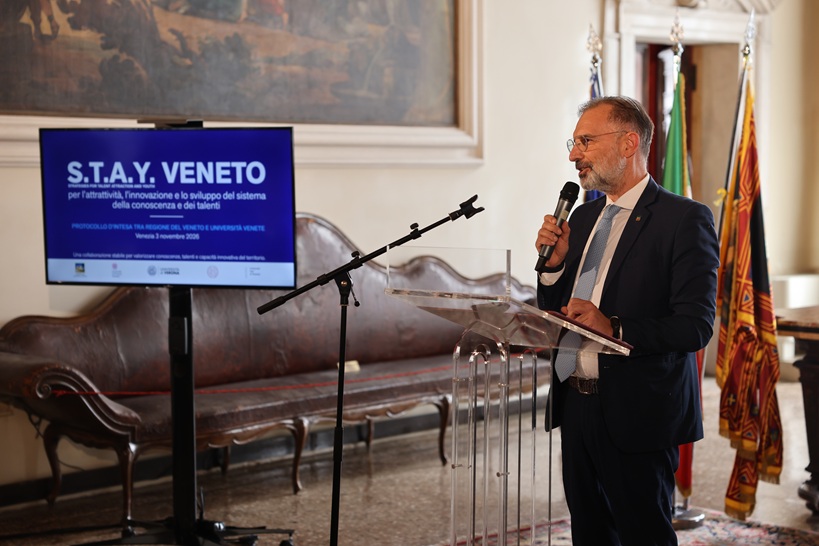
“Today, together with the four universities in the Veneto region, we are bringing together around the same table – permanently – those who train talent and those who employ it, those who carry out research and those who need researchers, to build a Veneto in which young people can find a concrete reason to stay, or to return. In a context marked by demographic decline, a shrinking younger generation, and a shrinking working-age population, the ability to make the most of those who have already been trained, retain talent, and attract new talent is an increasingly crucial factor for regional competitiveness and development. This is a strategic choice for the future of our young people and of this region, because we will always be students. I would like to thank Ca’ Foscari University, the University of Padua, the University of Verona and IUAV in Venice, along with their Vice-Chancellors: they have chosen to sit at this table in a spirit of teamwork ever since our first meeting in January, and without their contribution this initiative would not exist.”
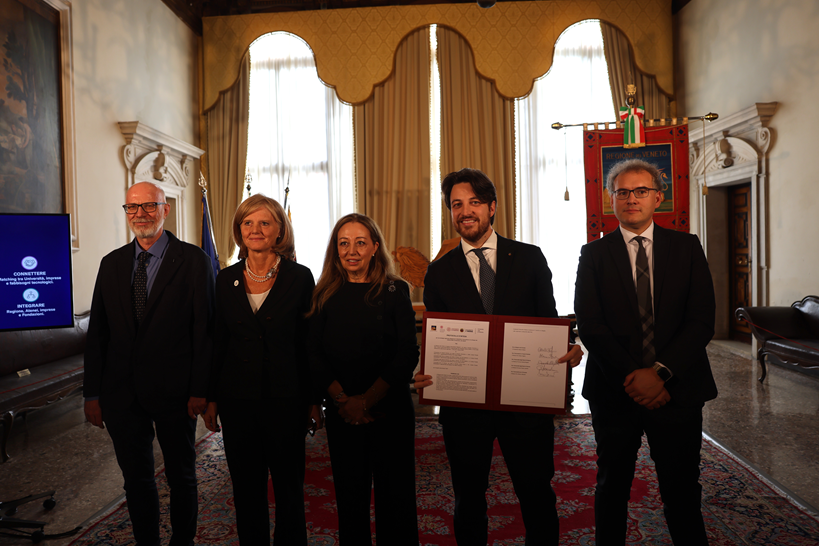
With these words, the President of the Veneto Region, Alberto Stefani, introduced this morning, at Palazzo Balbi, the presentation of the Memorandum of Understanding between the Veneto Region and the universities of the Veneto, signed with Ca’ Foscari University of Venice, the University of Padua, the University of Verona and the IUAV University of Venice.
The agreement, known as S.T.A.Y. Veneto – Strategies for Talent Attraction and Youth: for the attractiveness, innovation and development of the knowledge and talent system, sets out a process launched in January 2026, with the first meeting between the Regional Presidency and university leaders taking place on 13 January at Palazzo Balbi, and aims to make Veneto more attractive to students, researchers and young graduates, and to encourage them to stay or return.
Alongside President Stefani, the following spoke:
– Valeria Mantovan, Councillor for Education, Training, Skills and Culture;
– Massimo Bitonci, Councillor for Economic Development, Research and Innovation, and Investment Attraction;
– Marco Sgarbi, Rector of Ca’ Foscari University of Venice;
– Daniela Mapelli, Vice-Chancellor of the University of Padua;
– Chiara Leardini, Vice-Chancellor of the University of Verona;
– Benno Albrecht, Vice-Chancellor of the IUAV University of Venice.
The Memorandum of Understanding identifies four areas of common interest: intake and graduate placement, based on a shared information base regarding graduates’ employment outcomes; innovation, involving the mapping and regular presentation to the business sector of patents and other transferable research outcomes; a regional network of research infrastructure also open to businesses; and the attraction and retention of talent, including from abroad. In addition, there are three pilot initiatives: Life Project, Innovation and Living.
“The Memorandum of Understanding we are signing today marks the start of a stable partnership, which we had been hoping for ever since our first meeting on 13 January at Palazzo Balbi and which has developed over months of political and technical discussions,” continued Valeria Mantovan, Regional Councillor for Training and Education. “The point is simple: the quality of education is fundamental, but on its own it is not enough to make people choose the Veneto. Housing, transport, healthcare, services and job prospects all matter. Given the demographic decline we are facing, promoting those who study here, retaining talent and attracting new talent – including from abroad – is a matter of development for the whole region. For this reason, among the first lines of action are the ‘Progetto di vita’ and ‘Abitare’ initiatives: supporting young people as they make the transition after their studies and making it easier for them to remain in the Veneto’s university hubs. And the Round Table will serve to systematise what already exists, to make it more visible and accessible, and to understand, together with the universities and student accommodation organisations (ESUs), where needs remain unmet.”
A total of 30 million euros in regional funding has been earmarked for the shared pathway. Around 10 million of this is allocated to the ‘Life Project’, a pilot scheme designed to support young people who choose to remain in Veneto during the early stages of their independent lives: flexible support that can address practical needs such as housing, transport, training and welfare services. On a pilot basis, the scheme targets young people who rank in the top 10 per cent of master’s and single-cycle degree graduates from universities in Veneto, as well as ITS diploma holders, based on the results achieved at the end of their studies: a cohort of around 1,500 talented individuals, including approximately 1,200 degree graduates and 200 ITS diploma holders. Factors to be assessed include financial circumstances, academic merit and the alignment of the individual’s educational path with strategic areas of regional development. The proposal under consideration is an annual bonus of 3,000 euros for two years, with the criteria and implementation procedures yet to be defined.
“A further 20 million is earmarked for industrial PhDs, research grants and scholarships for young researchers, and applied research projects between universities and businesses, including proof-of-concept studies and prototypes,” Stefani explained. “In particular, industrial PhDs represent an excellent research pathway built around businesses’ innovation needs.”
“A region’s competitiveness today hinges on its ability to turn research into business, and businesses into places where researchers want to work. Through this initiative, we are bringing together the necessary tools: mapping universities’ patents and expertise; facilitating initial meetings between universities and businesses to align research outcomes with technological needs; industrial PhD programmes; research grants; and applied research projects,” added Massimo Bitonci, Regional Councillor for Economic Development.
As regards accommodation, the survey carried out with universities and the regional agencies for the right to education (ESU) currently shows 4,234 beds across ESU accommodation and university halls of residence, a figure projected to rise to 5,915 by 2029. This growth is accompanied by efforts to improve access to available options, including support with renting, guarantees, and other measures to help students remain in their accommodation. Housing is considered alongside transport, educational and care services, urban quality, and cultural opportunities, by enhancing and coordinating the provision offered by universities, ESUs, and local authorities; the aim is to make services more visible and accessible and to identify where needs remain unmet.
One of the first tangible outcomes of the discussions concerns healthcare for international students: the universities have launched initiatives with their respective local health authorities (Aziende ULSS) to facilitate access to essential healthcare services – in particular to general practitioners – on financially viable terms. These initiatives will be built upon, and consideration will be given to extending them across the region, including through community care homes and in accordance with the regulatory framework.
“Today, the Region and the university have chosen to look together towards the future of Veneto, and they do so in the knowledge that the future of a region depends increasingly on the quality of the knowledge it can produce, attract and retain,” said Marco Sgarbi, Rector of Ca’ Foscari University of Venice. “In the coming years, the Veneto region will have to contend with profound transformations that no single institution can tackle alone and which require a shared, long-term vision. Against this backdrop, the university’s role is changing and expanding ,providing young people with a sound education remains our fundamental task, as does helping to create the conditions within the region so that those young people can realise their ambitions here. The other half involves generating opportunities, supporting the creation of new businesses, strengthening the innovative capacity of existing ones, and guiding institutions in their strategic decisions with data, analysis and expertise. Ca’ Foscari intends to play a leading role in this process; we will put our research at the service of the Veneto’s major challenges and work to ensure that the knowledge we produce becomes a resource for the entire community.”
“For the first time, the universities of the Veneto region and the regional government have agreed on a common strategy regarding issues that are crucial for the future of our region,” continued Daniela Mapelli, Vice-Chancellor of the University of Padua. “This is a significant step, the result of a process of dialogue that began months ago, which enables us to pool our expertise, research infrastructure and capacity for innovation, overcoming the fragmentation of individual initiatives. We want to strengthen dialogue between universities and the business sector, making the most of the wealth of knowledge and expertise our universities offer and helping create high-quality opportunities for younger generations. Our role is not limited to education: it is also to foster the conditions for talented individuals we train to find opportunities for professional and personal growth within the region. The decision to establish a permanent coordination body gives continuity and substance to this shared vision.”
“This Memorandum of Understanding strengthens an already solid partnership and looks towards the Veneto region that we aspire to build together,” emphasised Chiara Leardini, Vice-Chancellor of the University of Verona. “A region capable of transforming knowledge into opportunities, innovation and growth. A region that puts people at the heart of everything and creates the conditions for them to choose not only to come here, but to stay and contribute to the future of our communities. The goal that unites us – the universities and the Region – is to attract young people and talented individuals, to nurture their skills and, above all, to create the conditions for them to choose to build their future here. This same vision inspires the University of Verona’s ‘Agenda Territori Attrattivi’ project, a strategy that focuses on students, young researchers and the quality of the university experience, in the knowledge that knowledge is one of the main drivers of development and regional attractiveness.”
“For the IUAV University of Venice, which this year celebrates the centenary of its foundation, this Memorandum of Understanding provides an opportunity to forge links with the Region and other universities in the Veneto region to foster a culture of design that has always integrated technical, scientific and humanistic expertise. The challenges outlined in the Policy Document – ranging from attracting talent to innovation and technology transfer, right through to urban regeneration – require precisely the ability to foster dialogue between different fields of knowledge. “The Permanent Round Table will enable us to do this on a sustained basis, whilst respecting the autonomy of the universities, and will contribute the expertise of architecture, design, spatial planning and issues relating to water and the sea to a Veneto region that is increasingly attractive to students, researchers and qualified professionals,” concluded Benno Albrecht, Rector of the IUAV University of Venice.